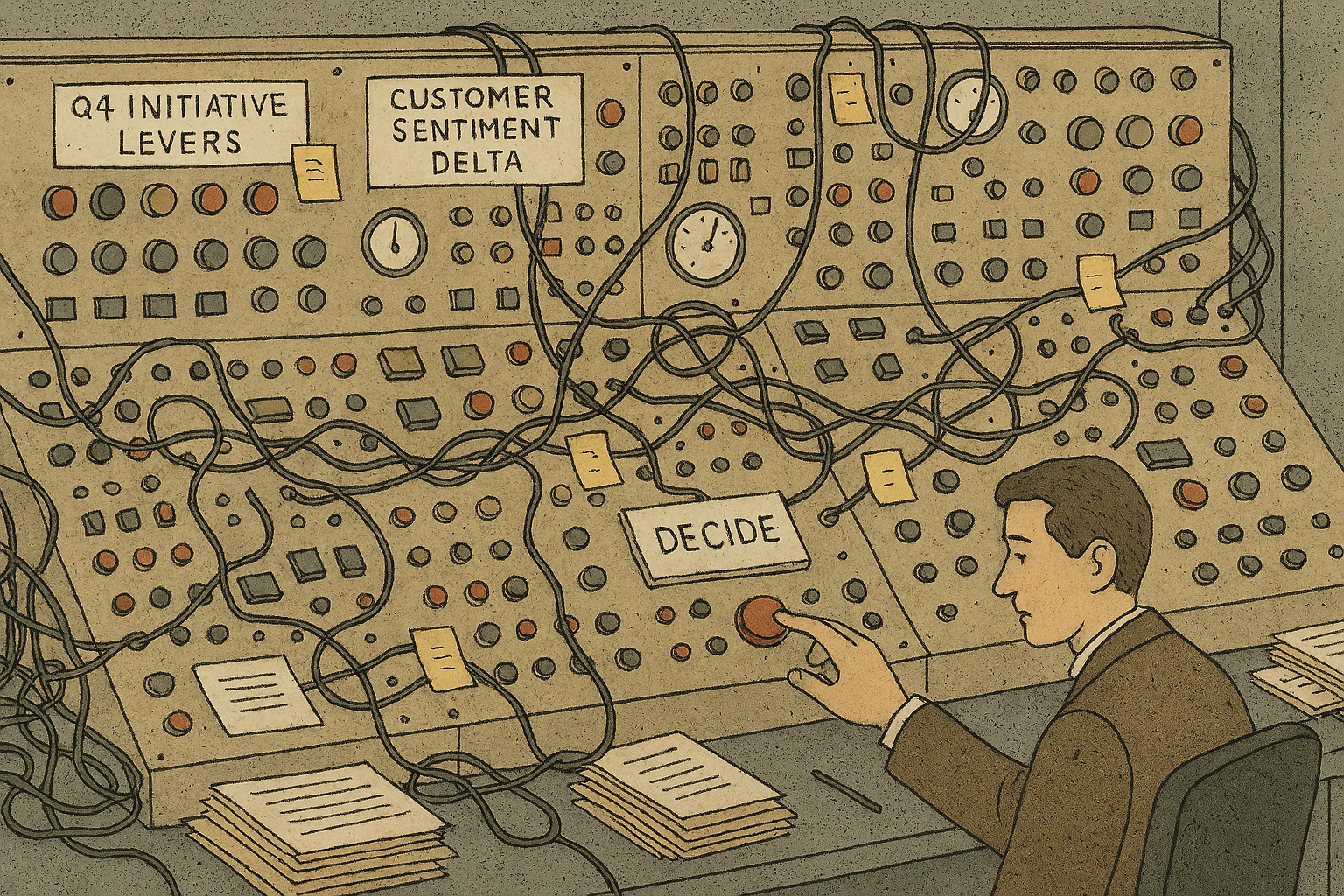
Despite all our dashboards, predictive models, and strategic workshops, many organizations still struggle to make timely, effective decisions. Why?
During our consulting projects over the past few years, we at Crow Intelligence (Orsolya Putz,PhD and me) have repeatedly encountered a term that immediately resonated with us: Decision Intelligence. Although the concept isn’t yet clearly defined, it seems to capture something essential about the challenges organizations face today.
At Crow Intelligence, we combine cognitive science, AI, and thoughtful design to help organizations make better decisions.
What is Decision Intelligence?
The straightforward definition from the Decision Intelligence Handbook describes it as “a methodology and set of processes and technologies for making better, evidence-based decisions by helping decision makers understand how the actions they take today can affect their desired outcomes in the future.”
But this definition only scratches the surface. What makes Decision Intelligence particularly interesting is how it sits at the intersection of multiple disciplines – cognitive science, data science, organizational behavior, and technology implementation.
The paradox of abundant intelligence
We find ourselves in a fascinating paradox. We have developed incredible machine learning solutions. Generative AI has made possible things that were previously unimaginable. Data flows abundantly through our organizations. Yet, as Forbes columnist Erik Larson notes, “decision-makers only use 22% of the jumble of data-driven insights they receive.”
The fundamental question remains challenging to answer: How should we use all this intelligence effectively?
When you think about it, using AI and ML to support decisions isn’t merely a technical challenge. It’s an organizational question. It’s about engineering choices. It’s about understanding the behaviors of both humans and machines within systems.
Beyond the “data-driven” mantra
Organizations often embark on “data-driven” or digital transformation initiatives simply believing that “more data = better decisions.” However, as many have discovered, this equation doesn’t always hold true.
The Decision Intelligence Handbook describes a scenario that made us nod in recognition: “Time and again, we’ve seen technical analysts open a meeting on a new project by saying, ‘Here are the data and AI models we have for you.’” We’ve witnessed this exact pattern countless times in our consulting work.
Presenting solutions before understanding problems is backward. How can analysts provide relevant insights without knowing what decisions need to be made?
Instead, Decision Intelligence suggests starting with the decision itself – understanding the outcomes you want, the actions you can take, and the causal chains connecting them. Only then can you determine what data is actually relevant.
The decision complexity ceiling
What many organizations are experiencing is what the handbook calls a “decision complexity ceiling.” The factors involved in major decisions have become so numerous and intricate that they exceed human cognitive capacity.
This complexity manifests in various ways:
- Longer, more complicated causal chains between actions and outcomes
- Rapidly changing decision environments
- Data that is partially available, uncertain, or difficult to interpret
- Diverse human perspectives and organizational politics
Traditional approaches to handling this complexity – gathering more data, building more models, improving information architecture – often add to the cognitive overload rather than alleviating it.
What draws us to Decision Intelligence
What fascinates us about Decision Intelligence is precisely this recognition that technology alone doesn’t solve decision problems. As cognitive scientists working in technology, we’ve always been interested in how humans and machines can work together more effectively.
Decision Intelligence offers a framework for integrating human expertise with technological capabilities. It acknowledges that decisions are fundamentally human activities, shaped by cognitive limitations, biases, and social dynamics – but that can be enhanced through thoughtful application of data and technology.
The approach feels refreshingly practical. Rather than promising AI-driven automation of all decisions, it recognizes that many important organizational decisions will remain “human-in-the-loop” for the foreseeable future. The goal is augmentation, not replacement.
Still evolving
It’s worth noting that Decision Intelligence is still an evolving field. As the handbook acknowledges, various organizations use the term with inconsistent meanings. Some focus heavily on technology while neglecting the human and process aspects.
What seems most promising is the balanced approach that considers all three “legs of the stool”: people, process, and technology. This holistic view aligns with our experience that successful AI implementation requires understanding both the technical possibilities and the human context in which they operate.
Learning the hard way: Technology alone isn’t enough
Our journey to this understanding wasn’t theoretical—it came through hard-earned lessons from our own projects.
Take Radioship, a project in which we were part of a consortium with civic radio stations, a journal, and several other partners. Within this collaboration, we worked on an elegant command-line tool for transcribing radio archives—technically sound and functionally complete. Yet it never gained momentum. Why? It failed to integrate into the radio stations’ workflows. It required a separate decision about which programs to archive, adding cognitive load rather than reducing it.
Similarly, Complytron (previously named Source Code Leak) was an early venture in which Zoltán served as a co-founder. It was initially designed to help investigative journalists by collecting technical information about websites—who registered them, where they were hosted, and similarities in source code. Despite the sophisticated technology, almost no one used it.
When the founders pivoted Complytron (later acquired by SEON), they took a different approach. Before building anything more complex than a database of entities, they mapped how KYC (Know Your Customer) analysts make their decisions. They learned to provide the necessary information without overwhelming them, to create calm interfaces for critical decision-making, and to find the right balance that empowered human judgment rather than replacing it.
These experiences taught us that understanding and supporting human decision-making is as crucial as technology, a core principle of Decision Intelligence.
Our Approach to Decision Intelligence
In our work, we follow the methodologies outlined in the Decision Intelligence Handbook while enriching them with Orsolya’s expertise in cognitive sciences and Zoltán’s 20 years of industry experience. We help organizations map complex decision spaces, identify key bottlenecks, and build hybrid solutions where human insight and machine intelligence work in tandem.
Decision Intelligence will become a defining capability of organizations that thrive in uncertainty. As cognitive technologies advance, those who understand how to integrate them effectively into human decision processes will have a significant advantage.
Have you encountered Decision Intelligence in your work? If this resonates with your challenges, we’d love to explore how these approaches might help. We’re always up for thoughtful conversations about the intersection of decision-making and technology.
Leave a Reply