Category: book review

  • Navigating Industry Transitions: Books That Helped Me Lead Data Science Across Domains

    Navigating Industry Transitions: Books That Helped Me Lead Data Science Across Domains

    If you’re a data scientist stepping into leadership roles or moving between industries, this post is for you.

    Leading data science teams across different industries has taught me that technical expertise alone isn’t enough—each domain comes with its language, stakeholders, and business logic. Over the years, I’ve moved from enterprise search to fintech/regtech, and now to social media analytics for the FMCG sector. Each transition meant learning not just new technical challenges, but entirely different ways of thinking about business problems.

    As a head of data science, I’ve discovered that the most challenging part of these transitions isn’t adapting algorithms or learning new tools—it’s understanding how each industry operates and communicating effectively with stakeholders who have completely different backgrounds and priorities. Here are the books that became essential guides through these domain shifts.

    (more…)

  • Narrative Wars: What Hunger Games Teaches Us About Information Control

    Narrative Wars: What Hunger Games Teaches Us About Information Control

    In his political essays, 18th-century Scottish philosopher David Hume, known for his empiricism and influential work on skepticism and political theory, made a penetrating observation about power: “Nothing appears more surprising to those who consider human affairs with a philosophical eye, than the easiness with which the many are governed by the few; and the implicit submission, with which men resign their own sentiments and passions to those of their rulers.”

    This insight – that rulers maintain control through “opinion” rather than force – seems eerily prescient in our current information landscape, where competing narratives battle for supremacy both between and within societies. With Suzanne Collins’ Hunger Games series receiving renewed attention through the release of “Sunrise on the Reaping,” we have a timely occasion to examine these dynamics through the lens of her dystopian world. Collins has explicitly cited Hume’s concept of “implicit submission” as her philosophical inspiration for the series, creating a fictional universe that takes information control to its terrifying logical conclusion.

    (more…)
  • Equality, What It Means and Why It Matters

    Equality, What It Means and Why It Matters

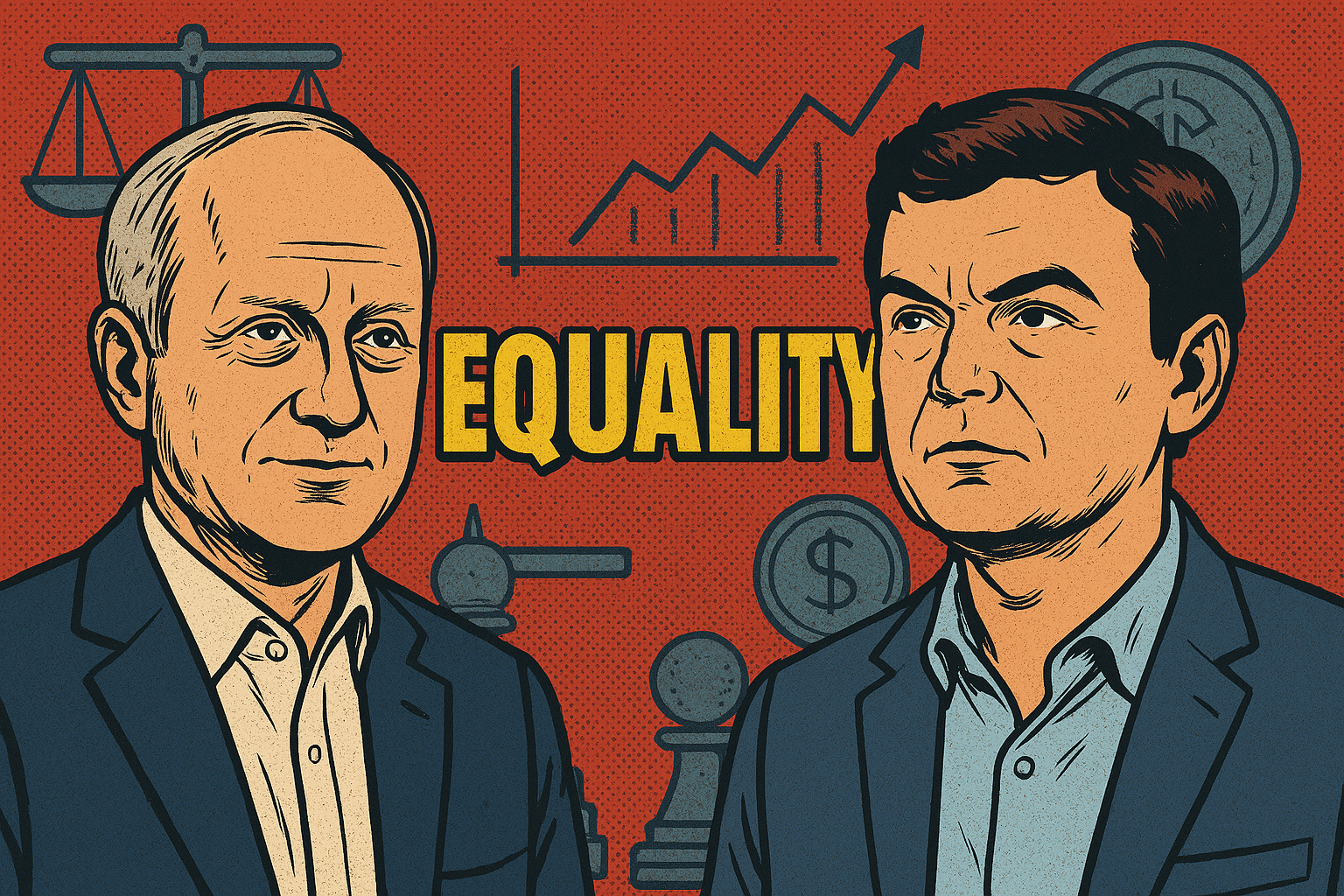
    I recently finished reading “Equality: What It Means and Why It Matters,” which captures a fascinating conversation between Michael Sandel and Thomas Piketty at the Paris School of Economics (May 2024). While this book is relatively brief, it builds upon two of the most important works of recent years: Sandel’s “The Tyranny of Merit” and Piketty’s “A Brief History of Equality.”

    (more…)
  • Statistical Thinking as Philosophy: Essential Readings – Part I.

    Statistical Thinking as Philosophy: Essential Readings – Part I.

    “Philosophy of science without history of science is empty; history of science without philosophy of science is blind.” — Imre Lakatos

    Statistics isn’t just a collection of mathematical techniques—it’s a way of thinking about the world, addressing uncertainty, and drawing conclusions from incomplete information. As data scientists, machine learning engineers, and AI practitioners, we often apply statistical methods without reflecting on their theoretical foundations. Yet our work implicitly embodies philosophical stances about knowledge, evidence, and inference.

    This series presents foundational readings that shed light on the philosophical aspects of statistics. They are not intended to turn data practitioners into philosophers, but to offer accessible ways to reflect on the assumptions that underlie our daily work.

    (more…)
  • Career Insights from The Software Engineer’s Guidebook

    Career Insights from The Software Engineer’s Guidebook

    As a Hungarian software professional, I was immediately intrigued by Gergely Orosz’s “The Software Engineer’s Guidebook” – not just because we share a national background, but because of its refreshingly pragmatic approach to career development. Orosz is no ordinary career advice author. Before becoming the voice behind The Pragmatic Engineer newsletter, he spent years in the trenches as a software engineer and engineering manager, giving his advice a level of authenticity often missing from theoretical career guides.

    (more…)